Why Hospitals are Rapidly Adopting RFID for Automation & Accuracy?
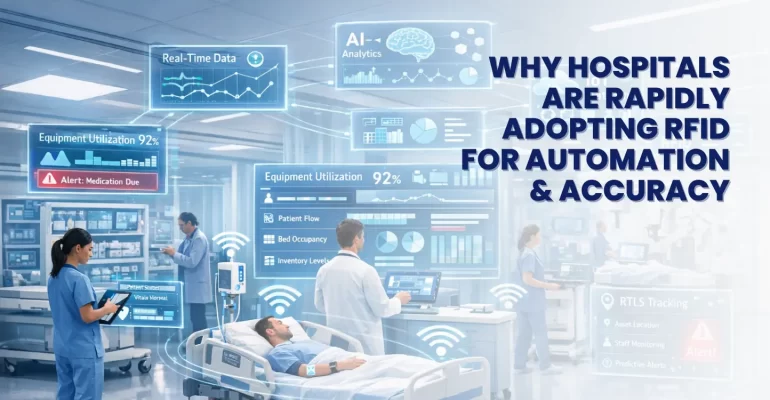
Why Hospitals are Rapidly Adopting RFID for Automation & Accuracy?
 Anshrah Neyaz
Hospitals today face constant pressure due to a high number of patients, complicated daily operations, and staff shortages. Many hospitals continue to use manual methods to monitor equipment, identify patients, and track inventory control. Often, this leads to a significant setback and mistakes in their work. Studies show almost 1 in 10 patients experience a certain kind of health care issue in a hospital setting, and these might actually be prevented. Stored equipment in a hospital can also hamper patient care, as nursing and other staff devote valuable time searching for equipment rather than devoting their full attention to patients.
As the healthcare facilities have grown, so have the demands of the patients; thus, hospitals need more intelligent and automated assistance. This requirement is met by the use of RFID technology, which helps in providing near-real-time analysis, accurate data, and automation in all operations undertaken at the hospital.
What is RFID Technology in Healthcare?
RFID technology helps identify, locate, and manage personnel, supplies, equipment, and drugs automatically using radio waves in a hospital setting. The RFID system consists of RFID tags, RFID readers, and RFID software that enable data collection and analysis without manual scanning or line-of-sight requirements.
RFID tags carry an identity number and are attached to assets, medical apparatus, or patient identification wristbands. Readers are installed around important locations such as wards, entrances, or storage areas, to gather the data from these tags and transmit it to a centralized software platform where reports and monitoring are done.
Hospitals use HF (High Frequency) RFID mainly for identity and access control, while UHF (Ultra-High Frequency) RFID is used for tracking assets over longer distances. In hospitals, the majority of the uses involve passive RFID labels, which do not have batteries and can be more cost effective.
RFID systems function by automatically identifying and locating items as they flow through medical processes in the health institution. In this way, immediate data entry and the automation of processes become possible. For this reason, it is clear that RFID systems are important in efficiency and patient safety in health sectors or hospitals.
Why Hospitals Are Rapidly Adopting RFID?
Since everything is undergoing a digitization process for ease of execution, the use of the RFID system is quickly finding its place in hospitals around the world so as to smoothen the processes. The major driving factors come from improved efficiency and accuracy in operations, whereby RFID automates data capture and eliminates much manual record-keeping.
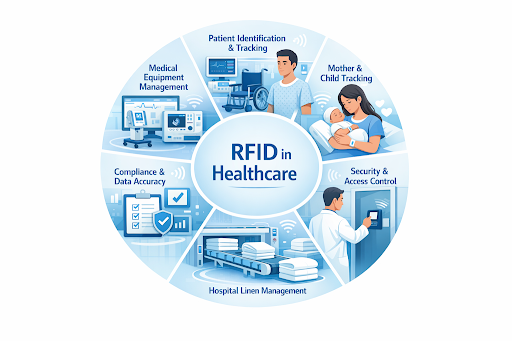
Medical Equipment Management
It helps in monitoring critical pieces of medical equipment such as infusion pumps, wheelchairs, and diagnostic tools in a real-time manner so that loss can be reduced.
Patient Identification and Tracking
RFID ensures proper identification and tracking of patients and allows for a quicker response to emergencies.
Mother & Child Tracking
RFID prevents newborn switching and abduction by allowing linkages to be established between mothers and babies in secure ways and allowing real-time monitoring in maternity wards.
Improved Security & Access Control
RFID prevents unauthorized access, as it will allow only authorized personnel to have access to sensitive areas of the hospital.
Hospital Linen Management
It has been found that an automated system based on RFID technology is capable of reducing losses, enhancing levels of cleanliness and hygiene.
Compliance and Data Accuracy
The use of RFID provides accurate and traceable audit paths, and hence improves compliance and data integrity within hospitals.
The Future of RFID Technology in Healthcare
The applications of the technology in the health sector are increasing, given the trend towards data-intensive operation management in hospitals. The data from the RFID technology in hospitals can be processed to provide estimates of equipment requirements, control the flow of patients, and determine the level of inventories.
With more hospitals installing intelligent infrastructure and digital systems, it can be safely assumed that RFID will remain a building block. When used along with other systems like RTLS, IoT platforms, and analysis tools, it can enable alerts and reporting.
In the future medical setting, RFID will help to provide increased accuracy and enhanced coordination of workflows and patient care.
Frequently Asked Questions
What is RTLS in healthcare?
Real-time location systems use multiple technologies like RFID, BLE, UWB etc. to track the real-time movement and location of people, assets, and things within the healthcare facility.
What are the key benefits of using RFID technology in hospitals?
RFID improves operational efficiency, asset utilization, patient safety, inventory accuracy, compliance, and real-time visibility across hospital workflows.
Which types of RFID tags are best for tracking medical equipment?
RAIN Tags (UHF RFID) are the best and most commonly used RFID tags for tracking medical equipment as they don’t require a battery, have a long read range, can be made very rugged to sustain extreme temperatures and also cost-effective.
How does RFID technology improve patient safety and quality of care?
RFID reduces identification errors, ensures correct medication administration, enables faster response times, and improves tracking of patient movement and treatment workflows.
How does RFID improve inventory accuracy?
RFID or RAIN RFID having long reading range, and not needing line of sight to read the tags, provides quick real-time stock visibility, preventing stock outs and overstalking of critical medical equipment and thus reducing manual errors/efforts.
Are there any challenges hospitals may face when adopting RFID technology?
The major challenges could be the initial cost of deployment, also, staff training and infrastructure planning, but with our expertise this can be addressed with correct hardware selection from the beginning, phase deployment and proper strategy.