From LF to UHF: How to Choose the Right RFID Approach
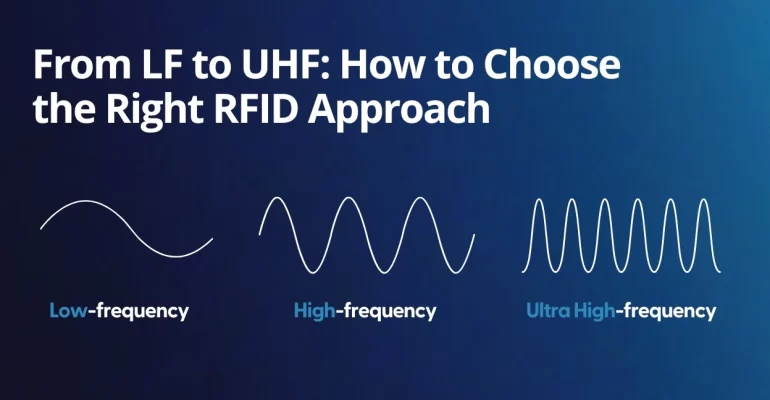
From LF to UHF: How to Choose the Right RFID Approach
 Anshrah Neyaz
Today, RFID technology is the basis of identification, tracking, and automation solutions in various forms across industries. From retail and healthcare to logistics and manufacturing, RFID provides organizations with real-time visibility and operational efficiency. But not all RFID systems operate the same. The frequency you select has a direct influence on read range, speed, accuracy, and overall system dependability. It is also for this reason that understanding HF RFID versus UHF RFID is important before making an investment decision. Choosing the correct frequency will guarantee that your RFID solution will function in conjunction with your environment, use case, and business objectives.
What is LF RFID?
Low Frequency (LF) RFID operates typically at 125 kHz or 134.2 kHz and uses inductive coupling (similar to HF but at a lower frequency). LF systems are known for their high reliability in challenging environments, especially around metal, water, and dirt.
LF tags have a short read range, usually from a few centimeters up to 10–20 cm, but they offer stable and consistent performance, making them ideal for applications where accuracy is more important than speed or distance.
LF RFID tags are generally more durable and less sensitive to environmental interference, but they tend to be more expensive than UHF tags and support lower data transfer rates.

Key Applications & Facts
- Primary Frequency: 125 kHz / 134.2 kHz
- Read Range: Near-contact to ~20 cm
- Applications: Animal tracking, access control, vehicle immobilizers, industrial automation
- Pros: Highly reliable near metal/liquid, stable performance, durable
- Cons: Very short range, slower read speed, higher tag cost compared to UHF
Where LF Fits in RFID Comparison
LF sits below HF and UHF in terms of range and speed but outperforms both in harsh environments. It is best suited for close-range, high-reliability identification use cases, especially where environmental interference is a concern.
What is HF RFID?
High Frequency (HF) RFID has a frequency range of 13.56 MHz with relatively small transmission ranges from a few cm to a maximum of 1 meter depending on the application being used. In the HF band, Near Field Communication falls under the ISO 14443/ISO 18000-3 normative context. It is adopted globally using the same frequency, 13.56 MHz. This allows NFC to be quite flexible across various sectors.
The cost of HF and NFC tags is relatively affordable, varying from $0.20 to $1, based on size. They may be purchased as stickers, cards, or packaged tags, with sizes compact enough to fit many applications. Because of magnetic induction powering, HF tags have lifetimes equal to the life of the application, unless damaged.
HF RFID readers are comparatively low-cost, in the sense that they would cost less than a hundred dollars. NFC tags can also be scanned through the use of the same HF readers, as well as through the use of NFC-equipped smartphones, and this has led to it gaining momentum at a rapid rate.

Key Applications & Facts
- Primary Frequency: 13.56 MHz
- Read Range: Near-contact to ~30 cm
- Applications: Access control, library systems, ticketing, passports, NFC marketing, gaming chips
- Pros: Global standards, NFC compatibility, larger memory options
- Cons: Short read range, lower data transmission rates
What is UHF RFID?
Passive UHF RFID operates within the 860–960 MHz range and relies on backscatter communication for functioning. The passive UHF tags have no batteries; instead, they draw energy from that broadcast by an RFID reader and reflect some part of it for data return.
Powered completely by the reader, passive UHF RFID tags are capable of long read ranges, typically 2–5 meters and up to 25–30 meters under ideal conditions. This makes UHF RFID quite fit for rapid, hands-free identification of many items at once.
Passive UHF tags are among the lowest-cost RFID tags available. Prices have fallen to $0.03 ‒ $0.5 a tag at quantity. They often appear as labels but come in robust on-metal, high-temperature and specialty formats. As they have no batteries, tag life is only limited by physical wear.
UHF RFID systems also tend to be more sensitive to metal and liquids, because these can reflect or absorb UHF signals. However, using on-metal tags, RF shielding, and proper system design can reduce performance issues. In general, UHF RFID readers are more expensive than HF readers and range in price from $450 to $1500 depending on the features and ruggedness.

Key Applications & Facts
- Primary Frequency: 860–960 MHz
- Read Range: Near-contact to ~25 meters
- Average Tag Cost: $0.09–$20
- Applications: Inventory tracking, supply chain, asset tracking, race timing, laundry, tolling
- Pros: Long read range, low tag cost, fast data transfer, global standards
- Cons: Higher reader cost, sensitive to metal and liquids
UHF Frequency Bands in Different Regions or Countries
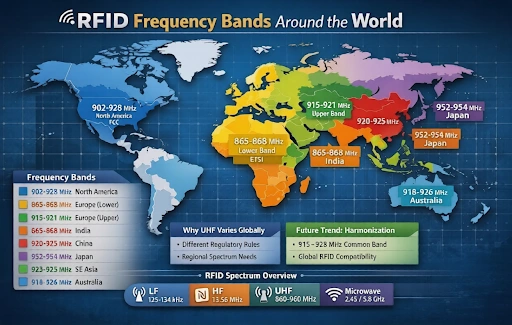
UHF Radio-Frequency Identification uses various frequency bands depending on the regions. In Europe, UHF Radio-Frequency Identification operates at 865-868 MHz; on the other hand, it works within the 902-928 MHz frequency band in US, while some regions of Asia employ UHF Radio-Frequency Identification between 920-925 MHz.
Key Differences Between RFID HF and UHF
HF and UHF RFID differ significantly in range, speed, and use cases. Understanding these differences helps businesses select the right technology based on operational needs, environment, and scalability requirements.
HF vs UHF RFID: Full Comparison Chart
| Parameter | HF RFID (High Frequency) | UHF RFID (Ultra High Frequency) |
| Operating Frequency | 13.56 MHz | 860–960 MHz |
| Typical Read Range | Up to 30 cm | Up to 10+ meters |
| Read Speed | Moderate | Very High |
| Cost | Moderate | Lower at scale |
| Applications | Access control, payments, libraries | Inventory, logistics, asset tracking |
| Environmental Sensitivity | Performs well near liquids | Sensitive to metals/liquids (improving) |
[ Want more insights like this? Explore the ID Tech blog and stay updated.]
Which RFID Frequency Is Right for Your Business?
When deciding whether to go with HF, UHF, or a combination of both, your choice will depend on your intended utilization of the technology. In cases whereby your specific task may involve secure, proximity communication, then HF RFID may be your best option.
On the other hand, if your company is concerned with the accuracy of inventory or the tracking of assets within a larger area such as a warehouse or distribution center, the efficiency of UHF RFID is unparalleled. Retailers, manufacturers, and third-party logistics companies are increasingly turning to UHF systems for real-time capture.
Environment, which involves metal, liquid, and harsh conditions, tag form factor ensuring appropriate size, durability, attachment, and consistent performance on the asset, reader infrastructure defining how efficiently data is captured, whether through short-range precision or long-range bulk scanning, and government regulations around frequency bands, power limits, and compliance standards are all equally important in this decision-making process. This is where expert advice and consultation can help. ID Tech ensures complete support from determining the right frequency of your RFID tag to achieve maximum results for your application.
Whether it’s HF or UHF RFID, integrating the technology with your business goals means that you can enjoy long-term benefits of Return on Investment (ROIs). Find more on our RFID Consulting Services or get in touch with ID Tech for specific advice on your projects.
Frequently Asked Questions
Which RFID technology is better for inventory management: HF or UHF?
UHF RFID systems are more suited for inventory management as they offer a long reading range along with multiple item scanning functionality. They also allow for quick scanning of inventories in real time at a warehouse or retail store.
What are the best RFID tags for use in harsh outdoor environments: HF or UHF?
UHF-RFID tags are generally deployed in an outdoor setting, especially rugged and metallic tags, providing satisfactory performance in a logistics yard, port, and industrial environment, depending on the selection of the tags and the environment where the tags are enclosed.
What are the main differences between HF and UHF RFID technologies?
Differences exist in the operating speed, read distance, speed, and uses of HF and UHF. HF is generally used in short-distance, secure environments and in UHF in long-distance tracking of high volumes.
Are HF RFID and NFC the same?
NFC is a subset of HF RFID, and it operates at the frequency of 13.56 MHz. Not all HF RFID communications support NFC communications, although all NFC communications are classified as HF RFID. To better understand the differences in efficiency, range, and applications, check out our detailed guide: RFID vs NFC.
What is the read range of RFID tags?
The reading distances for HF RFID tags and UHF RFID tags differ, with an estimated few centimeters for the HF tags and several meters for the UHF tags depending on the tag and reader configurations.